Friday, September 15, 2006
Au Revoir Sihanoukville
Monday, August 28, 2006
EAO Salesian Brother's Convention

 26th.
26th.So, what is a Salesian Brother? He's a "lay person" and yet "a consecrated religious." Don Bosco envisioned them to be in places or works where priests cannot or would not thread. Being a lay person he is able to be involved in the world, and yet being consecrated he is commited to poverty, chastity, and obedience, and of course community life.
Saturday, August 05, 2006
Sentenced Home
The other day I chanced upon a Korean television program (“Heart to Heart”) an interview with film maker David Grabias. His latest film (with Nicole Newnham) entitled: “Sentenced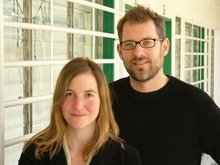 Home” touches the plight of around 1400 American-Khmers being forced to return to
I’ve read a line before which says: “Home is where your heart is.”
Saturday, July 29, 2006
People you meet in the morning
Yesterday on my way back to Sihanoukville from
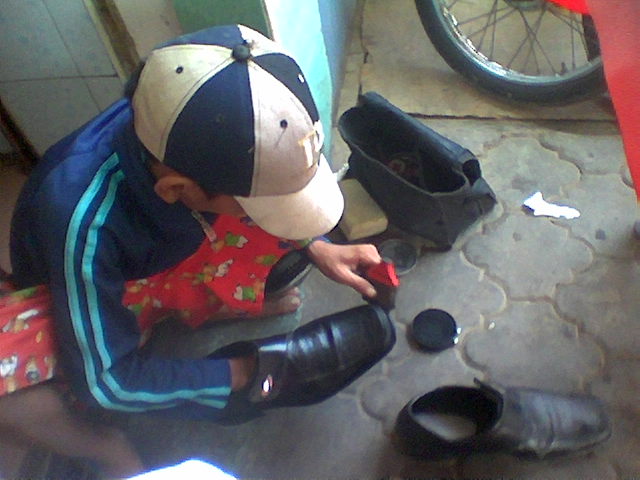 Just then a shoe shine boy accosted me but seeing that I was wearing rubber slippers, he quickly excused himself. I thought that if I were wearing leather shoes or sandals I could have parted with some of my money for this boy who was honestly trying to earn a living. But there was no need for that since another man next to me employed his services and he started on his early morning work just beside where I was eating my bowl of noodles.
Then an elderly man on crutches approached me and begged for some money. I didn’t seem to care because I said to myself that although he was physically handicapped, he could still earn a living doing something other than begging. Fortunately for him, the couple sitting on the next table offered him some loose change.
Now I was really feeling uneasy with myself.
I remembered one of those sayings: “If you have food in your refrigerator, clothes on your back, a roof over your head and a place to sleep, you are richer than 75% of this world.”
Suddenly, a monk appeared in front of me barefooted and dressed in his worn-out saffron robe, carrying an umbrella in one hand and a begging bowl on the other. Without thinking twice, I took out a few riels to put in his begging bowl.
That night I slept soundly.
Wednesday, July 19, 2006
Move, moved, moving (again)
I’m moving to another community again. I’ve been given my new obedience (assignment) - Poipet by September. Funny, I haven’t finished unpacking and now I’ll have to pack them up again. People keep asking me how I feel about moving...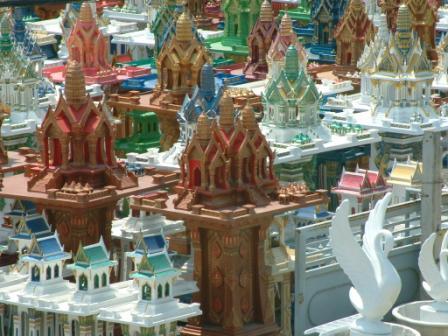
Well, I think that moving can always have a significant meaning to any person. To the fearful it could be threatening because things might get worse. To the hopeful it could be encouraging because things might get to be better there. To the confident it could be inspiring because of the challenges one could meet.
But I’m not telling what it is for me -to keep you guessing.
Saturday, July 01, 2006
Can you spot the difference?

Last Christmas I took this photo of three Dominican Sisters together with some Filipinas. The picture was taken after the Mass in the makeshift church since renovations started in the main church. Today, after six months of adaptation here in Sihanoukville, I once again took their photo with the same Filipinas (with some additionals) this time in front of the newly-renovated church right after we finished the Mass. Can you spot the difference?
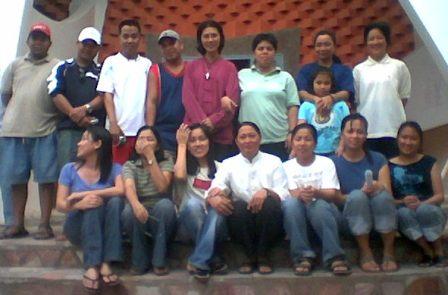
The religious habit is actually the symbol for poverty. During the middle ages (when most of the mendicant orders started) the habit being the same for all in a particular monastery or convent saw to it that no one was richer or poorer than the other brothers or sisters. Ironically, to have a religious habit made today costs more than the average man's clothes. Anyway, habit or no habit, Don Bosco once said: "It is not the habit that makes one a religious but virtue."
Monday, June 26, 2006
The World Cup & Development of the Poor
There's this nice picture and tantalizing question in the Dropping Knowledge website. (your question.org)
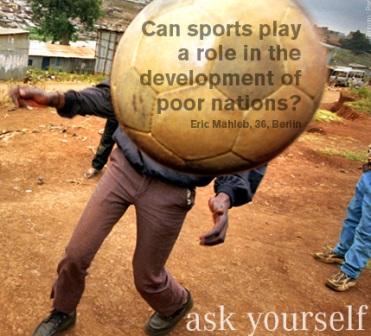
"Can sports play a role in the development of poor nations?"
I believe it can. Many years back I found myself coaching and playing football with the poor kids in the slums of Tondo, Manila. This made me seriously ponder about their future: "are they just going to play football all the time; what's in this for them?"
Being good in the game, many of them got scholarships to pursue their studies in many universities who needed good footballers. Later on I saw others make a living by becoming professional football referees, while others became coaches and trainers. Football has certainly given them a good alternative to break the circle of poverty.
Football is but a drop in the bucket. I've seen others rise from poverty through other sports in my own backyard... I've seen it in other Don Bosco settings in many other countries, and I believe it's going to happen too here in Cambodia.
When I was a novice in this congregation, we used to tease jokingly (no offense intended) about other congregations too... like how it was a "sin" if the Franciscans and Augustinians missed their prayers, how it was a "sin" if the Dominicans missed their study period, and how it was a "sin" for us Salesians if we missed our daily scheduled games/sports. Now I begin to realize why Don Bosco emphasized on this for us.
Sunday, June 25, 2006
"x-culturation"
Enculturation refers to the transmission of cultural traditions from one generation to the next. It is the process in which an individual from the time of his birth is taught the social norms, behavior and customs of the group where he belongs. For example in the western culture, when one faints or gets sick, only the doctor (expert) goes with the patient and everybody distances away to "give room." Here in Cambodia, when you faint, everybody tries to grab a part of your body (nose, ears, hands, feet, head) and massages it in order to keep you "alive" (conscious). This knowledge and behaviour seems to have been engrained in everyone since childhood. This must be probably due to the "compassionate" character of the culture where one should not be left alone especially in difficult times.
Acculturation is the transmission of cultural traditions from anybody who "knows" to anyone who does not know. This occurs when an individual or group which is aware of the existence of another culture adopts the said culture. A very good example is how the Khmers have adopted "French bread" in their diet and in their cuisine. They have also incorporated the chinese "Guay-thiow" or noodles in everyday life. Fashion trends from clothes to hairstyle are changing due to "global" influence. All that is acculturation.
(There'll be more -culturation terms like inculturation, intraculturation, interculturation, etc. but that will not be our focus.)
Thus one's culture (present tense) is a product of both enculturation and acculturation. Culture therefore evolves and is a dynamic reality.
These two concepts not only form my "national" culture but also my "religious" culture.
They also apply to the growth of my spiritual relationship with You. There are things I've learned about You from my parents, my teachers, my elders when I was young - "enculturation."
There are things I continue to learn about You from my own experiences
and from the examples and witness of people I've met, I've worked with and I've worked for, and from discussing these things with you in 'prayer'- "acculturation."
Hence my relationship with You is a product of the past and the now - it is dynamic just like you.... Hey, didn't they say that You are the God of the living and not the dead?
Friday, June 16, 2006
Pedagogical Upgrade
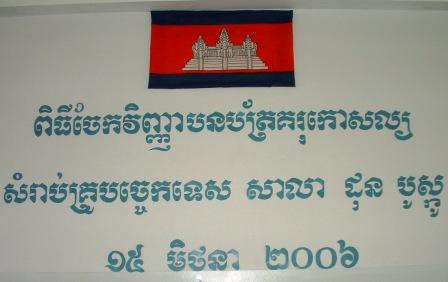
Twenty-five instructors/teachers from our school received their certificates from His Excellency Sabaong Sarat (governor of Sihanoukville). Mr. Keo Lay from the Ministry of Education Youth & Sports confirmed their worthiness after the teachers underwent a month-long training seminar given by the same Ministry (MOEYS). The two-hours a day hectic grind upgraded their knowledge on pedagogical skills and at the same time increased their awareness on the teacher's code of ethics.

There is a Cambodian saying which goes: "Jeh min chneah jong" (skill cannot defeat will). I believe that if we are experts in teaching only skills, then we will produce a generation of experts without a conscience - productive hands without a compassionate heart. True success is when our knowledge and skills are tempered by our right attitudes and values.
Saturday, June 03, 2006
Going the Full Circle
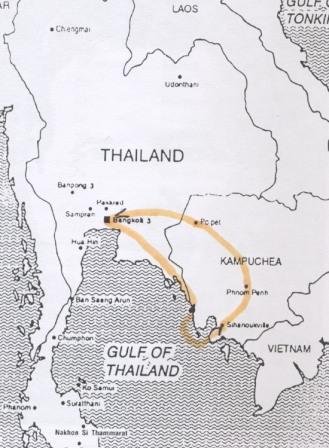
I needed to go to Bangkok for a medical check-up. This time instead of taking the plane (costs more than $100 RT), I decided to take the full circle journey: "To Bangkok and Back."
Monday, 29 March - took the bus from Sihanoukville to Phnom Penh ($3)
Tuesday, 30 March - took the bus from Phnom Penh to Poipet border ($7)
Wednesday, 31 March - crossed the border and off to Bangkok ($7)
I went for my check-up at the Hospital- Thursday, 1st of June. I then contacted a van that goes to Khlong Yaay (Thailand)- Koh Kong (Cambodia) which left the house at 3AM Friday ($15). I arrived early morning at 8am at the port of Koh Kong to take the boat ($15) to Sihanoukville. At around 1PM the boat docks at the Sihanoukville port.
Home Sweet Home on 2nd of June. A coming full circle journey!
They say that: all things in life travel a full circle. My origin is where I shall return. My source will be my destination. This is what I believe in. This is what I hope for. My journey today reminded me of that (and so does the scientist's yo-yo in my profile).